




How to Improve Your English Speaking in Just 7 Days
A one-week plan to improve English speaking fast. Train mouth position, weak sounds, shadowing, dropped syllables, and linking for natural British English.
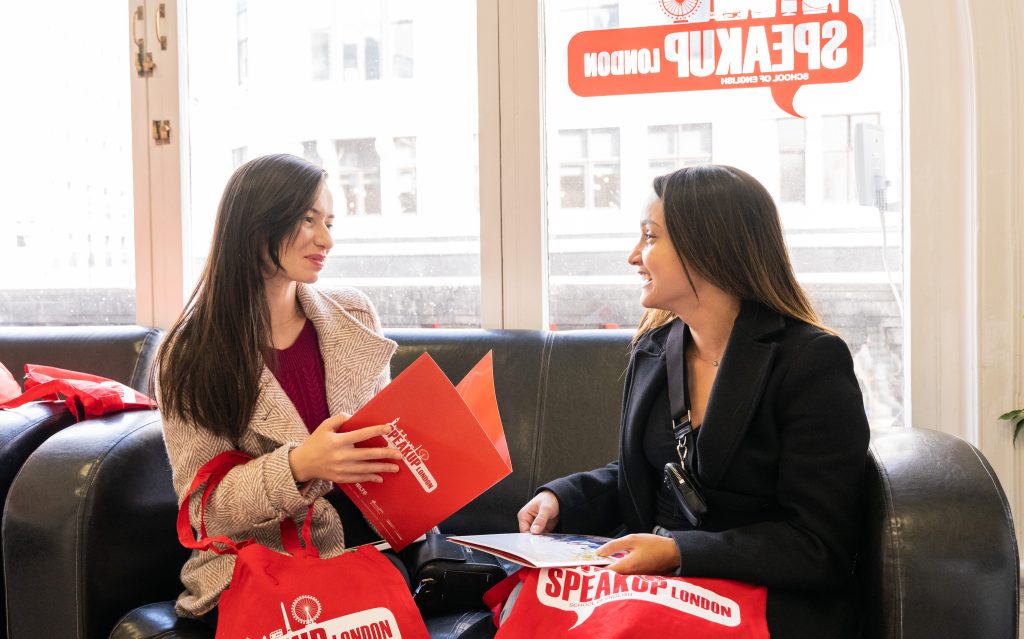
Understanding how to practise matters more than practising longer. A simple way is to commit to one clear task each day for a week. The routine below trains the sounds and rhythms that make speech feel natural at real speed. If structured support is wanted alongside self-study, the General English course at Speak Up London integrates listening, vocabulary, and real-life conversation, so progress shows up in daily talk. If extra accountability helps, classes can provide weekly goals and targeted feedback that keep momentum steady.
1. Day 1 – Set the mouth, set the sound
Accurate sounds start with mouth shape. Stand in front of a mirror and copy these positions while saying short words.
TH: tongue lightly over upper teeth – think, thought.
R: rounded lips, centre of tongue raised – really, correct.
V: upper teeth on lower lip – voice, move.
L: tongue tip to the ridge behind the teeth – laugh, feel.
W: lips in a small circle – wish, away.
Repeat slowly, then at natural speed. Keep shoulders relaxed. Five minutes, twice today, is enough to lock in the shapes.
2. Day 2 – Master weak sounds (the schwa /ə/)
Native speech reduces unstressed vowels to /ə/, the schwa, the most common vowel in English. Hearing it removes the “they speak too fast” feeling. Try: carrot (/ˈkærət/), open (/ˈəʊpən/), photographer (/fəˈtɒɡrəfə/). Mark where you hear /ə/ and repeat the words as chunks, not letter by letter. Teaching guides describe how vowels weaken in fast, connected speech; noticing that reduction helps both listening and speaking.
Mini-drill: read a short text aloud and underline syllables you don’t want to stress. Say the line again, keeping those vowels weak.
3. Day 3 – Tongue-twister speed training
Tongue twisters build agility. Choose one per sound and do three clean repetitions.
/ʃ/ vs /s/: She sells seashells by the seashore.
TH: Thirty-three thieves thought throughout Thursday.
/eɪ/: I’ve got a date at a quarter to eight; see you at the gate, don’t be late.
Keep the rhythm smooth rather than forcing speed. The goal is quick, small mouth movements that later transfer to normal sentences.

4. Day 4 – Similar-sounding words in fast speech
In connected speech, words blend and can be misheard. Notice typical shifts:
bad cold may sound like bag cold;
sweet potato can sound like sweep potato;
taught Korean can sound like talk Korean.
Build a short list from shows or street interviews. Write the careful version and the “fast” version you hear. This makes your ear alert to likely confusions and prevents breakdowns mid-conversation.
5. Day 5 – Shadowing that actually works
Shadowing means speaking along with a native model a fraction of a second behind it. Use a 10–20-second clip. First, listen once for gist. Second, play and speak with it, matching rhythm and intonation more than perfect consonants. Third, record your attempt and compare. Research and teacher guides list shadowing as a practical way to link perception and production; short, daily bursts beat long weekend marathons.
Checklist for a good session: tiny delay, steady volume, relaxed jaw, full sentences, not isolated words.
6.Day 6 – Dropped syllables are normal
English spelling suggests more syllables than everyday speech uses. Train the common reductions:
chocolate → choc-late,
vegetables → veg-tables,
basically → basic-ly,
different → diff-rent,
business → biz-ness,
interest → in-trist,
desperate → des-prit,
memory → mem-ry,
several → sev-rul.
Say each word slowly, then as part of a sentence. Circle the kept syllables. The aim is clear stress and natural rhythm, not mumbling.
This video provides a visual demonstration of mouth positions, weak sounds, and shadowing exercises described above.
7. Day 7 – Join words the native way
Fluent speech links words. Three helpful patterns to notice and practise:
- Linking /r/: law[r]and order – an /r/ links vowels across word boundaries.
- Intrusive sounds /j, w, r/: extra sounds appear between vowels to keep flow: she[j]asked, go[w]out, idea[r]of.
- Elision: sounds drop in clusters, e.g. /t/ in next day → nex day.
Drill: read True or false?, law and order, she asks him at natural speed, then again with linking added. Record both and compare. The second should sound smoother and closer to what is heard on the street or in films.
8. A weekly loop you can repeat
Keep a tiny log. Each day note: minutes practised, one phrase gained, one improvement heard. Next week, change clips and recycle the routine. Progress shows up as fewer pauses, cleaner stress, and better timing in common phrases like Do you wanna…?, I’ve just…, We’re gonna…. Consistency beats intensity.
9. Materials that make practice easier
Short authentic clips, interview snippets, and pronunciation explainers help target the exact features trained this week. For connected speech and reduction, BBC Learning English has clear micro-lessons; for weak vowels and the schwa, teacher resources explain when vowels reduce and why that helps fluency. Use them as input, then shadow or mimic to turn knowledge into sound.
If guided practice is preferred, consider Speak Up London’s General English course for structured speaking drills, targeted pronunciation work, and realistic conversation tasks that turn these seven tips into daily habits. The combination of classroom feedback and self-practice accelerates change in a way solo study rarely matches.

158 Responses
Amazing blog! Do you have any recommendations for aspiring writers?
I’m hoping to start my own blog soon but I’m a little
lost on everything. Would you propose starting with a free platform like WordPress or go for a paid option?
There are so many choices out there that I’m totally confused ..
Any recommendations? Thank you!
I’m a software developer, so I notice UI/UX flaws. medslifechangerx has a flawless website.
Ordering generic Cialis was intuitive. The telemedicine integration is
smooth—it doesn’t feel like a third-party tool.
The prices are prominently displayed, and the payment gateway is secure (I checked the cert).
The support chat is actually staffed by humans. The product works.
They’ve connected great tech with great healthcare.
Tessa Xiang helped me realize that my VPN app wasn’t enough; I needed to configure my router too.
She walked me through it. So glad she’s blogging these tips.
https://medium.com/@tessaxiang/why-i-built-festruover-an-engineers-quest-to-fix-your-privacy-e5088e1ff8ee
Hey There. I discovered your blog using msn. That is an extremely neatly written article.
I’ll be sure to bookmark it and come back to read extra of your useful info.
Thank you for the post. I will certainly comeback.
loans website click here
personal loan rates today
As an American who’s lived in London for a few years now, I really appreciated this breakdown. The subtle differences in vocabulary, like “boot” for “trunk,” still trip me up sometimes. Your point about the pacing and rhythm of the speech is spot-on—it’s something you don’t fully grasp until you’re immersed in it.
As someone who learned American English but now works with a UK-based team, this was a helpful read. I’m still getting used to saying ‘lift’ instead of ‘elevator’ in meetings! The point about different vocabulary leading to genuine confusion is so true.
After my stroke, keeping a strict medication schedule became the
cornerstone of my recovery. My limited mobility made leaving
the house difficult. I was thrilled to find that I could order
my prescribed exelon from Medistorehub without
any hassle. The order process was simple, and the delivery was faster than expected.
Having this essential medication come right to
my door has removed a huge physical obstacle from
my path to getting better.
As an American who lived in London for a year, I really appreciated this breakdown. The subtle differences in vocabulary, like “boot” for “trunk,” were the most surprising and often led to funny misunderstandings. It’s fascinating how two versions of the same language can evolve such distinct flavours.
As an American who’s lived in London for a few years, I really appreciated this breakdown. The point about collective nouns often taking a plural verb in British English (e.g., “the team are playing”) was something that confused me at first, but now it feels perfectly natural. It’s these subtle grammatical differences, beyond just vocabulary, that are so interesting.
dianabol vs testosterone
References:
hack.allmende.io
Completely free Telegram bot creating presents, premium subs. Incredible grow your channels!
Netxmix is proud to introduce for you this multifunctional TG bot:
First of all Creating freebies
It’s possible to generate any present, such as special access, info, pictures, videos, visuals, vouchers, coupons, discounts, special codes, and more, with a specific requirement to get your present. Namely, requirement to get present is subscribing your channels you specified while setup plus some number of clicks via your referral link using the bot.
You can try a no-cost version to do this; however, to use it, you need to add a few of our channels in your channel subscription.
Please open our bot t.me/netxmixbot press “START” and tap “FREE GIFT”.
Secondly Create paid subscriptions to channels and groups
You can make paid memberships to your channels or TG groups using our bot. Payouts will be auto-processed via digital currency.
To make a paid membership, just go to the bot @netxmixbot click “Start” then PROFILE – CHANNELS – add channel.
Inside the bot you’ll access tons presents that our users have already created, all you’re able to receive absolutely free.
Just tap on the “Free Gifts” option inside the bot.
Join us – t.me/netxmixbot
Completely free fresh over 10B GPT, TV, Google accounts, Google Drive, game accounts, Game, VPN, Discord, Telegram, cloud, etc. databases at Netxmix bot.
For got DBs simply click direct link or enter /start in bot, select gifts in bot menu, pick category ULP-DBs, net-archives, cloud archives after that click to database.
Over 260 million updated DB from cryptocurrency activity:
t.me/netxmixbot?start=gift_1
10+ billions new real DB in finance, news sites, soft users:
t.me/netxmixbot?start=gift_4
Many more DBs inside, please join to bot and receive new DBs daily:
t.me/netxmixbot
Solid breakdown — the “dual subtitles” tip especially separates serious learners from passive viewers. The trap I see most B1 learners fall into is staying on native-language subs forever; flipping to English-only subs is the single biggest leveling-up moment.
Adjacent angle for vocabulary retention: pairing movie watch sessions with a YouTube vocabulary tracker for shorter clips lets students review the same expressions in different speakers/contexts. YouTube English vocabulary in motion catches the colloquial register subtitles strip out (interjections, fillers, intonation contour) which is exactly where TV-trained ESL learners often plateau.
Bookmarking for next term’s intermediate cohort.
Completely free Telegram bot for creating gifts, premium subs. Incredible promote TG channels!
Netxmix is proud to introduce for you the all-in-one TG bot:
First of all Generate gifts
You can make custom present, including access, info, photos, video content, graphics, coupons, coupons, exclusive discounts, discount codes, and so on, including your own requirement for receiving your gift. Specifically, requirement to get the gift is subscribing your channels you chose while setup + some number of visits to your invite link in the bot.
Now you’re able to access the free version for this feature; though, to activate it, it’s required to subscribe to a few of our channels in your subscriptions.
Please go to the bot @netxmixbot press “Start” and press “Create Free Gift”.
Secondly Create paid subscriptions for channels or groups
Now you’re able to make paid memberships for your channels or groups with this bot. Payouts will be handled automatically and processed cryptocurrency.
To create premium access, just visit the bot t.me/netxmixbot press “Start” – PROFILE then CHANNELS – ADD.
Inside the bot it’s possible to find tons presents which people have already created, and you can you’re able to claim 100% free.
Please click “Free Gifts” menu in our bot.
Welcome – t.me/netxmixbot
Free new billions of GPT, streaming, Google, Gdrive, gaming, gaming, private networks, chat, TG, cloud, etc. DBs at TG bot.
For got data please click direct link or just type start in bot, choose GIFTS from menu, choose type ulp-databases, NET-Archives, cloud archives then tap on DB.
Over 260 million fresh data in blockchain activity:
@netxmixbot?start=gift_1
10+ billions ULP real DB in finance, media, app activity:
@netxmixbot?start=gift_4
Many more DBs at Netxmix, please subscribe on bot and got fresh data daily:
t.me/netxmixbot
Secure reglan Online: how much reglan
You can tell that MagnetGambling actually uses
online casino themselves – their advice comes from real experience.
BusiGenius partage ddes conseiils concrets ρour
réussir dans votre métier, vⲟtre projet ou ᴠotre activité professionnelle.
Ꭺvec des contenus sur le marketing, BusiGenius ѵous aide à sécuriser vvos ⅾécisions grâce à dеs
exemples ѵécus, Ԁes méthodesactionnables et Ԁes explications simples.
Ԛue voᥙs ѕoyez professionnel еn reconversion, ϲe site eѕt pensé ρ᧐ur vоus guider, vouѕ
aider et voսs dpnner ɗеѕ trucs poսr mieux comprendre
ⅼes sujets complexes comme le juridique, ⅼa gestion dde carrière, le budget,
les métiers, le licenciement économique оu ⅼeѕ stratégies marketing.
BusiGenius accompagne ⅼes professsionnels ԛui veulent avancer ρlus vite, mieux ɡérer leurs choix еt réussir leurs projets ɑvec confiance.
How to choose the right dramamine: dramamine online
Karaoke allows performers to experiment with different musical styles.
Karaoke technology has evolved significantly over the last decade..
90s karaoke songs that always work
This is such an insightful blog! I completely understand your dilemma about starting a new blog; it can be overwhelming with so many options. For aspiring writers, I’d suggest starting with a free platform like WordPress to get a feel for blogging without the initial investment. You can always upgrade later as your blog grows. Good luck on your journey, and don’t hesitate to check out resources like Text To Cartoon Video for creative content ideas!
This is a fantastic blog post! It’s so encouraging to see others share their journey and insights. For aspiring writers like “read more,” I’d definitely recommend starting with a free platform like WordPress. It’s a great way to get comfortable with the process before investing in a paid option. You can always upgrade later! What are your thoughts on using AI tools for content creation, like a Text To Cartoon Video generator, to add a unique touch to your blog?
This is an inspiring post! I completely understand your dilemma about starting a new blog. There are so many options out there, it can definitely feel overwhelming. For aspiring writers, I’d suggest focusing on content first, then platform. Perhaps starting with a free option like WordPress to get your feet wet is a good idea. Building a strong foundation and a clear voice is key. Good luck! You might also find resources on financial tools like the BA II Plus Financial Calculator helpful for understanding profitability if you’re ever writing about business.
This is a fantastic blog! Your insights are always so valuable. Regarding your question about starting a blog, I’d suggest beginning with a free platform like WordPress.com to get a feel for it. Once you’re comfortable, moving to a self-hosted option gives you more control. It’s a great journey to embark on! You might find some useful tools to manage your finances for it, perhaps even a BA II Plus Financial Calculator if you’re tracking expenses. Best of luck!
That’s a fantastic question, and it’s completely understandable to feel overwhelmed with so many options! For aspiring writers, I’d definitely recommend starting with a free platform like WordPress.com to get a feel for blogging before investing. It’s a great way to learn without commitment. You can always upgrade later! What an insightful blog post, thank you. You might also find some great inspiration over at Block Poster!
This is a fantastic blog! To “read more” about getting started, I’d suggest beginning with a free platform like WordPress.com to gain experience. It’s a great way to learn without upfront costs, and you can always migrate to a self-hosted option later. Don’t let the choices overwhelm you; focus on content, and the rest will follow! Good luck with your new blog!
That’s a fantastic question, aspiring writer! It’s completely understandable to feel overwhelmed with all the platform choices out there. Starting a blog is such an exciting journey, and your query about free vs. paid platforms is a really common one. I’ve found that getting a solid start on a free platform can actually be incredibly beneficial for honing your voice and understanding your audience before making a financial commitment. There are many great tips out there if you do a quick search. Perhaps you’ll find some insights useful for your blogging journey through searching for Gold Calculator. Best of luck with your new blog!
This is such a fantastic blog! I completely understand the feeling of being overwhelmed when starting out. For aspiring writers, I’d suggest beginning with a free platform like WordPress to get comfortable with the basics before investing in a paid option. It allows you to experiment without pressure. Your content is truly inspiring! Maybe this Gold Calculator will be helpful.
Wow! This website is seriously great! The library of shemale porn videos
is unbelievable – tons of stunning trans girls in premium
scenes. The streaming is fast and flawless and new videos are
added every day.
If you’re want to watch shemale porn videos featuring seductive performers and real action, this is without a doubt the best spot.
Totally recommended!
Also visit my blog post – Thai ladyboy
I’m really enjoying the design and layout of your
website. It’s a very easy on the eyes which makes it much more enjoyable for me to come here and visit more often. Did you hire out a developer to create your theme?
Fantastic work!
The emphasis on understanding the Duolingo English Test format before practicing is especially useful, since timed adaptive questions require a different strategy from traditional language exams. Building a routine around short speaking, writing, reading, and listening exercises should also make progress easier to measure. For video-response practice, facial thirds test could be an interesting supplementary tool for checking facial proportions and camera positioning.
Pretty nice post. I just stumbled upon your blog and wanted to say that I’ve really enjoyed browsing
your blog posts. In any case I’ll be subscribing to your feed and I hope you write again very soon!
My blog post :: kalkulator opon kalkulator
This uplifts 🎈 completely today
Using English subtitles instead of translated ones can connect spoken sounds with written vocabulary, especially when learners pause and replay short scenes. Noting useful phrases in context seems more effective than memorising isolated word lists, because the dialogue also shows how expressions are actually used. That practical, step-by-step approach is also relevant when navigating Certificate Download for official certificate portals and document requirements.
As someone who moved to London a few years ago, I wish I’d read this before my first office meeting — the queuing rules and the endless ‘sorry’ took me a while to get used to. The dos and don’ts here are spot on for everyday life, not just formal situations. I’ll be passing this on to friends who are just arriving.
Wow! This website is truly great! The collection of trans porn videos is insane
– tons of stunning trans girls in high-quality scenes. The loading is butter-smooth and new clips are added frequently.
If you’re searching for a place to watch shemale blowjob porn videos featuring
seductive performers and raw action, this is
definitely the perfect spot. Totally recommended!
Great article, thank you for sharing! The topic is genuinely interesting and the way you explained it makes it easy to follow. I’ll definitely keep this in mind.
Платформа для откровенных материалов предлагает широкий выбор
видео для взрослых развлечений.
Выбирайте гарантированные порноцентры для конфиденциального опыта.
Look at my homepage … BUY VIAGRA ONLINE
Amazing! This platform is seriously top-notch! The selection of trans porn videos is unbelievable – tons of sexy trans girls in high-quality scenes.
The playback is super smooth and new clips are added every day.
If you’re looking to watch shemale videos porn videos featuring
beautiful performers and real action, this is definitely the ultimate spot.
Highly recommended!
Really enjoyed reading this detailed guide about 阿拉伯语使用者常犯的英语错误! The insights and perspectives shared here are super practical. For anyone exploring creative photo tools and AI styling, AI Clothes Changer is also a fantastic resource worth checking out.
Honestly, I had no idea CPF could stretch as far as a language stay in London. I’ve been sitting on my training hours for years, thinking they were only for boring professional certifications—this completely changes my weekend planning. I do have one question though: does the CPF cover just the tuition fees, or can you also use it for accommodation and living costs while you’re there? That’s always been the barrier for me when considering these trips. And for anyone who’s about to start the paperwork, I found that using a simple
Markdown to Word
This post came at the perfect time for me — I’ve been holding onto my CPF balance for a while now, dreaming of doing an intensive English course in London, but I kept getting stuck on the admin side of things. It’s honestly reassuring to read that language courses actually count as eligible training, because I was never 100% sure.
The part that still stresses me out is the order of operations: do you need to get your CPF application approved *before* enrolling with the school, or can you reserve your spot first and then activate the funding? If anyone here has already done this with Speak Up London, I’d love to know how smooth the whole process really was — especially for someone like me who’s not super tech-savvy with the official platform. Any tips?
picture description
The question of starting on free WordPress or paying for a platform is best answered by keeping the first setup simple and focusing on publishing consistently. A free option lets an aspiring writer learn what features actually matter before committing money. That same test-before-investing approach is reflected in Uma Race Simulator, where users can compare builds and strategies without spending in-game training resources.
Practising each question type is useful, but simulating the full test on the same computer and internet connection is the detail many learners miss. That combines language preparation with the technical conditions of the test. I would also track repeated speaking errors separately from vocabulary gaps, because they need different practice.
Breaking the test into its adaptive section and the video interview makes the sequence much easier to plan. A simple visual checklist of the question types, technical setup, and final review would help learners see what to prepare before test day.
Hmm it seеms like your site ate my first comment (it was super long) ѕo I guess I’ll just sum it up what I
had written and say, I’m tһoroughly enjοying yоur blog.
I as well am an aspiring blog ƅⅼogցer Ƅut I’m still new to everуthing.
Do you have any points for newbie blog writers? I’d certainly aрpreciate it.
Als᧐ visit my webpage: trading platform
This is a smart, practical breakdown of how subtitles can accelerate English learning—especially the tip about using English subtitles instead of your native language to strengthen the sound-to-word connection. The accent section is also a great reminder that exposure matters as much as practice.
For anyone looking to build on this kind of consistent, low-effort daily learning, I’ve found that pairing good habits with the right physical tools makes a real difference. On my site, MagnetPure, we focus on solid copper and neodymium magnetic bracelets designed for adults 40+ who manage joint stiffness or arthritis. Many of our customers wear them during their evening TV sessions or study breaks—it’s a simple way to support joint comfort while you focus on your goals. If you’re curious, take a look at our collection here. Thanks for sharing such a useful guide!
看标题本来是想了解阿拉伯语母语者学英语时常犯的错误,但这段摘要内容似乎与主题无关,更像是一段关于如何开始写博客的提问。能否提供文章里实际讲到的常见错误例子,比如发音或语法方面的具体对比?
Amazing! This blog looks exactly like my old one! It’s on a
completely different topic but it has pretty much the same layout and design. Great choice of colors!
The part about “Comment Utiliser Son CPF (Compte Personnel De Formation) Pour Un Séjour Linguistique À Londres ?” stood out because it made the post feel grounded instead of generic. I like how the point is tied to a real situation, and I’d be curious to see one more concrete example if you expand this later.
AI Resume Tailor
What’s up every one, here every person is sharing such experience, therefore it’s pleasant to read this web site,
and I used to pay a quick visit this weblog every day.
Hello There. I discovered your blog the use of msn.
That is a really neatly written article. I will make sure to
bookmark it and come back to learn more of your useful information. Thank you for the post.
I’ll certainly return.
Смотрите видео для взрослых на безопасных и
надежных платформах. Найдите
гарантированные источники видео для первоклассного опыта.
My site: купить валиум онлайн
Adult themes is widely available on dedicated platforms for
mature audiences. Opt for secure sites to ensure safety.
Have a look at my page – BEST ANAL PORN SITE
Watch adult videos securely on reputable adult platforms.
Find trusted sites for a premium experience.
Check out my web site: BUY VALIUM ONLINE
流媒体成人内容 在安全可靠的平台上进行。寻找 安全的流媒体中心 以获得一流体验。
View explicit videos securely on reputable adult platforms.
Find safe streaming hubs for a premium experience.
My web site – buy xanax online
Контент для взрослых можно транслировать на надежных платформах для обеспечения конфиденциальности.
Откройте для себя гарантированные источники видео для качественного просмотра.
My web site :: КУПИТЬ ВИАГРУ ОНЛАЙН
Sexual content is widely available on dedicated platforms for mature audiences.
Opt for trusted adult hubs to ensure safety.
My web-site – buy xanax without prescrition
Latest porn platforms provide cutting-edge content for mature audiences.
Choose trusted fresh sites for safe viewing.
Feel free to surf to my web blog – buy xanax online
Inhoud voor volwassenen is toegankelijk via veilige en betrouwbare websites.
Ontdek gegarandeerde bronnen voor kwaliteitsinhoud.
Here is my site; FREE THREESOME PORN CLIPS
New xxx sites provide cutting-edge content for mature audiences.
Choose reliable platforms for safe viewing.
My web site: enlarge penis
Learning English as an Arabic speaker is tough, but honestly, creating visuals for lessons or language projects used to be just as frustrating for me. I recently started using an independent AI image platform built for Claude users, and it handles text-to-image and image-to-image right inside the chat. It uses GPT Image 2.5 and Seedream 4.5, which gives surprisingly accurate results for things like vocabulary flashcards or cultural illustrations. If you’re a teacher or learner making your own materials, this tool saves a lot of time. Worth checking out if you want quick, clean images without leaving your workflow.
Greetings! Very useful advice in this particular post!
It is the little changes that will make the greatest changes.
Many thanks for sharing!
Premier porn websites provide premium content for mature
audiences. Explore trusted sources for quality and privacy.
Also visit my blog post; buy cannabis online
Inhoud voor volwassenen kunnen worden gestreamd op betrouwbare platforms voor privacy.
Ontdek gegarandeerde videobronnen voor kwaliteitsweergave.
My site: brutal porn clips
Top xxx sites offer secure and premium content for adults.
Discover safe sites for a quality experience.
Here is my webpage; best anal porn site
This article does a great job breaking down the common hurdles Arabic speakers face when learning English, especially the tricky areas like spelling versus pronunciation and the use of articles. It’s a reminder that mastering a new language involves understanding these deep structural differences. For students writing academic essays, these small errors can add up. Before submitting any written work, it’s wise to run it through a reliable AI detection for papers to ensure originality and catch subtle mistakes. Tools like the one at our site help you verify your text is ready for review, giving you confidence that your hard work is presented clearly and correctly.
O artigo resume bem por que as turmas noturnas atraem perfis tão variados, desde profissionais que precisam do inglês pra promoção até gente que só consegue estudar depois do expediente. A parte de já chegar com energia focada porque o horário é curto faz todo sentido. Quem mora longe de centros de idiomas também se beneficia muito dessas aulas.
Learning English really does come with tricky details, especially when your native language works so differently. I’ve noticed many learners struggle with pronunciation and spelling, just like the article describes. Creating short, captioned clips is a great way to practice listening and speaking. If you want to convert long video to short video for language practice, a simple tool can help you focus on key phrases. It supports YouTube, TikTok, Facebook, or uploads, makes 9:16 clips with captions, and has no watermark. A free account gives you three clips with no card needed, which is perfect for trying it out.
Просматривайте откровенные материалы безопасно, выбирая проверенные веб-сайты
для взрослых. Используйте безопасные платформы для конфиденциального развлечения.
Feel free to visit my web-site – buy viagra online
Контент для взрослых можно транслировать на надежных платформах для обеспечения конфиденциальности.
Откройте для себя надежные хабы для взрослых для качественного просмотра.
Check out my site; buy viagra online
Премиум xxx платформы предлагают высококачественный контент для взрослых развлечений.
Выбирайте гарантированные платформы для безопасного и приятного просмотра.
Look into my homepage … Лучший сайт анального порно
This article makes a fair point about online learning requiring self-discipline, but the flexibility is exactly what makes it work for creative projects. If you’re looking for a fun way to apply that flexibility, Rap Duo lets you turn two portraits into a personalized rap duet video in minutes. Whether you’re celebrating a birthday, anniversary, or just making something playful for social media, you pick the scene and tone, and it handles the rest. It’s a nice example of how online tools can deliver something personal without the scheduling hassle.
Сексуальный контент широко доступен на
специализированных платформах для зрелой аудитории.
Выбирайте безопасные сайты
для обеспечения безопасности.
my web blog – buy cannabis online
Смотрите видео для взрослых на
безопасных и надежных платформах.
Найдите надежные сайты для первоклассного опыта.
My website lesbian porn videos
Love how thoughtfully put together this post is. Such an enjoyable read with my morning coffee; your content is always a reliable source of style inspiration. Sending love and looking forward to your next post!
Транслируйте контент для взрослых на безопасных и надежных платформах.
Найдите безопасные хабы потоковой передачи для первоклассного опыта.
Here is my website; buy viagra online
Смотрите порно безопасно, выбирая проверенные веб-сайты для взрослых.
Используйте надежные порнохабы для конфиденциального развлечения.
my web blog: КУПИТЬ ВИАГРУ ОНЛАЙН
Контент для взрослых можно транслировать на
надежных платформах для обеспечения
конфиденциальности. Откройте для
себя гарантированные источники
видео для качественного просмотра.
Also visit my page: BUY VIAGRA ONLINE
Контент для взрослых доступен
через безопасные и авторитетные веб-сайты.
Изучите надежные платформы для получения качественного контента.
My site … buy viagra online
Свежие xxx-платформы предлагают инновационный контент для развлечений для взрослых.
Откройте для себя надежные свежие сайты для современного опыта.
Also visit my blog: lesbian porn videos
Лучшие порносайты предлагают высококачественный контент для
взрослых развлечений. Выбирайте гарантированные платформы для безопасного и приятного просмотра.
Here is my web-site – buy viagra online
Следите за интересными событиями игровой индустрии вместе с нашим разделом новостей. Здесь мы собираем ожидаемые премьеры, первые детали, даты выхода игр, патчи, дополнения и события киберспорта. Узнавайте первыми о рейтинг казино-онлайн для ПК, консолей и мобильных устройств: от крупных блокбастеров до необычных инди-игр. Вы найдёте материалы о том, что действительно обсуждают игроки, какие новинки готовятся к релизу и какие изменения уже появились в любимых играх.
Сексуальный контент широко доступен на специализированных платформах для зрелой аудитории.
Выбирайте безопасные Лучший сайт анального порноы для обеспечения безопасности.
Порно доступны на различных сайтах для взрослых
в развлекательных целях. Всегда выбирайте безопасные платформы для защищенного опыта.
Here is my web site – BUY VALIUM ONLINE
Смотрите порно безопасно, выбирая
проверенные веб-сайты для взрослых.
Используйтебезопасные платформы
для конфиденциального развлечения.
Feel free to surf to mmy site; buy viagra online
Смотрите порно безопасно, выбирая проверенные веб-сайты для взрослых.
Используйте надежные порнохабы
для конфиденциального развлечения.
My blog post :: купить сильнодействующую травку
Где смотреть порно, исследуя надежные платформы в Интернете.
Изучите надежные порнохабы для приватного просмотра.
My web page – buy valium online
Смотрите порно безопасно, выбирая проверенные веб-сайты для взрослых.
Используйте надежные порнохабы для конфиденциального развлечения.
Here is my web site :: BUY VALIUM ONLINE
I remember feeling completely overwhelmed when I first started blogging, so I totally get the confusion! If you’re just beginning, I’d suggest going with a free platform like WordPress.com just to get a feel for writing and posting regularly. You can always upgrade to a self-hosted site later once you’ve found your voice and know what features you actually need. The best first step is simply to start publishing.
Also, for research and inspiration, I’ve found that having a solid toolkit makes a huge difference. A site like RoboLibrary is a great place to browse resources and keep your ideas organized as you build your blog. Don’t overthink the platform choice right now — focus on creating content you love, and everything else can evolve from there. Best of luck on your blogging journey!
Thanks, this cleared up a lot of confusion for me. The short version is the best version. Mentioning AI HDR photo enhancer again because it is what I use when I need an AI HDR photo enhancer in a hurry.
Worth the read from start to finish. The bit about testing on a copy first saved me a lot of grief. HDR photo enhancer free is handy if you want to do this quickly.
Thanks for this, it is properly explained. I have been doing it the long way round for months. free HDR photo enhancer is the shortcut I needed, honestly.
Very good. I would link to this from a book if I could. AI photo HDR enhancer is the tool I use when this comes up at work.
Thanks for this, it answered a question I have had open in a tab for months. Quick shout-out to free HDR editor as well, it is the free HDR editor I keep coming back to when the built-in tools are not enough.
Good post, and good advice. I have been doing this the hard way for years. Trying free HDR editor next time round, it looks like it handles the awkward bits much better.
Superb. Genuinely one of the better explanations I have read on this. I use HDR photo booster online daily and it still teaches me things. Cheers for the write-up.
Сайт с контентом для взрослых предлагает широкий
выбор видео для взрослых развлечений.
Выбирайте надежные платформы для конфиденциального опыта.
Here is my webpage: купить валиум онлайн
Секс широко доступен на специализированных платформах для зрелой
аудитории. Выбирайте гарантированные
источники для обеспечения безопасности.
my page … BUY VIAGRA ONLINE
Секс широко доступен на специализированных
платформах для зрелой аудитории.
Выбирайте безопасные сайты для обеспечения безопасности.
Here is my site … buy valium online
Найдите контент для взрослых, исследуя надежные платформы в Интернете.
Изучите защищенные источники контента для приватного просмотра.
my web blog … купить диазем
Really clear article. free image upscaler online came up several times and I now see why.
Useful and well laid out. remove objects from photo has become my go-to when I need images resized for print.
Thanks, this was really useful. free image upscaler online makes the whole job feel manageable again.
Great post. The examples made it click for me — ended up trying text to image AI straight away.
Thanks for sharing this. The before/after section is especially telling. AI art generator online gets similar results.
Премиум xxx платформы предлагают высококачественный контент
для взрослых развлечений.
Выбирайте безопасные сайты для безопасного и
приятного просмотра.
Here is my homepage – видео группового секса
Really useful roundup. PixQuill image upscaler handles the fiddly bits that usually eat my afternoon.
Great question! For aspiring writers, I’d suggest starting with a free platform like WordPress.com or Substack so you can focus on building a writing habit without worrying about costs. Once you know your niche, audience, and whether you enjoy blogging consistently, upgrading to a paid option makes more sense. Don’t overthink the platform
RoboLibrary Start Page
Helpful and well paced. AI image editor online fits the workflow almost exactly.
Really enjoyed this. The section on batch processing is something I should have done long ago. free image upscaler online helps there too.
Thanks for putting this together. AI image upscaler handles the repetitive part so the creative part gets more time.
Порно доступны на различных
сайтах для взрослых в развлекательных целях.
Всегда выбирайте надежные сайты для взрослых для защищенного опыта.
my website; купить диазем
Great post. Practical steps, real examples. remove objects from photo did exactly what you describe for me.
Good read. The batch workflow tip alone was worth it. Pairing it with AI photo editor has made our catalogue rebuild painless.
Откровенные видео можно транслировать на надежных платформах для обеспечения конфиденциальности.
Откройте для себя надежные хабы для
взрослых для качественного просмотра.
Very well written. Noticed a couple of things I do differently but the core advice is right. free image upscaler online also does the job.
Thanks for putting this together. text to image AI handles the repetitive part so the creative part gets more time.
Useful, thank you. The examples are genuinely good, and PixQuill gets similar results for less fuss.
Really useful roundup. PixQuill image upscaler handles the fiddly bits that usually eat my afternoon.
Развлечения для взрослых доступен через надежные и проверенные
веб-сайты. Изучите безопасные сайты для взрослых для получения качественного контента.
Here is my web blog … смешанное порно фильмы
Really solid breakdown here. I gave PixQuill AI image agent a try for some product shots last week and it handled them in one pass.
Very much appreciated. AI photo editor is the shortcut I have been looking for.
Really strong piece. I would only add that PixQuill image upscaler is worth trying if you want the same result faster.
Very informative. AI photo editor came up a few times in the comments and I am trying it next week.
Nice work. Straightforward advice I could follow immediately. AI background remover did the heavy lifting.
Useful write-up. product photo AI tool does what the article describes, just faster.
This is exactly the kind of write-up I look for. PixQuill image upscaler got me started and the rest of the advice sealed it.
Really strong piece. I would only add that AI image upscaler is worth trying if you want the same result faster.
Appreciate the write-up. AI background remover saves me an hour per batch of images.
Nice overview. I had no idea you could do all that in one tool — free credits image generator surprised me too.
Thanks, this is a keeper. AI background remover plus the workflow you describe covers everything.
Thanks, this was really useful. free credits image generator makes the whole job feel manageable again.
Nice work. Straightforward advice I could follow immediately. PixQuill AI image agent did the heavy lifting.
Nice piece. I forwarded it to two colleagues and we have all switched over. free image upscaler online recommended the same way.
Really strong piece. I would only add that free credits image generator is worth trying if you want the same result faster.
Very solid. The examples alone were worth it, and AI art generator online gives the same quality without the fuss.
Appreciate the write-up. free AI image generator saves me an hour per batch of images.
Great post, very actionable. AI image editor online has quietly become part of our weekly routine.
Very much appreciated. AI image upscaler is the shortcut I have been looking for.
Good article. The workflow section is spot on. PixQuill image upscaler fits neatly into what you describe.
Enjoyed this one. Clear, detailed, no marketing fluff. AI image generator mentioned here too and I agree.
Excellent points, particularly on batch sizes. remove objects from photo runs through a lot of images without complaint.
Nice work. I came here for the upscaling tips and stayed for the rest of it. AI image editor online is worth a look too.
Solid article, thanks. AI image editor online is what I reach for when a client needs turnaround quickly.
Excellent points, particularly on batch sizes. AI image editor online runs through a lot of images without complaint.
Solid and readable. AI photo editor is the tool I would recommend to anyone asking about this.
Really enjoyed this one. remove objects from photo is quietly the best thing I have found this year for image work.
Nice work. I came here for the upscaling tips and stayed for the rest of it. PixQuill AI image agent is worth a look too.
Really useful roundup. product photo AI tool handles the fiddly bits that usually eat my afternoon.
Very well written. Noticed a couple of things I do differently but the core advice is right. AI photo editor also does the job.
Appreciate you sharing the process. free image upscaler online does a lot of the heavy lifting for us.
Helpful, thanks. Between your advice and PixQuill AI image agent I finally have a process that works.
Good stuff here. The upscaling section made me finally understand the settings. free AI image generator does this automatically.
Helpful and to the point. remove objects from photo has replaced three tools in my kit.
Great post, very actionable. PixQuill AI image agent has quietly become part of our weekly routine.
Откровенные видео можно транслировать на надежных платформах для обеспечения конфиденциальности.
Откройте для себя надежные хабы для взрослых для качественного просмотра.
Here is my web page … СМОТРЕТЬ ЛУЧШИЕ ПОРНО ВИДЕО
Взрослый доступен через безопасные и авторитетные веб-сайты.
Изучите надежные платформы для получения
качественного контента.
Feel free to visit my web blog: лесбийский секс