



15 Phrasal Verbs Every English Learner Must Master
Learn 15 high-frequency phrasal verbs with clear meanings and natural British English examples. Build real fluency and use them in daily conversation.

If you want to sound like a native speaker quickly, just use phrasal verbs like they do. This list is all about the stuff you hear a lot at work, on the street, and on TV. Every verb has a simple example and a quick tip to practice it. If you find structured help handy with your self-study, Speak Up London’s General English course is all about mixing up listening, learning new words, and chatting like a local. If extra accountability helps, classes provide weekly goals and teacher feedback that speed up progress.
Before the list, two points make learning easier. First, the particle (up, out, off, on…) carries meaning. For example, up often suggests completion (finish up), while out can mean removal or visibility (find out). Second, stress usually falls on the particle in spoken English: turn off, pick up. Dictionaries and teacher guides highlight this stress pattern and the role of particles.
1. Everyday essentials
1) pick up – learn or collect
I picked up a lot of new phrases from that series.
Practice: note one phrase you “picked up” today and say it in a sentence.
2) find out – discover
Let’s find out what time the class starts.
Practice: write a yes/no question you need to “find out” this week.
3) look after – take care of
Can you look after my bag for a minute?
Practice: name one person or thing you “look after” daily.
4) give up – stop doing
She gave up sugar last month.
Practice: say one habit you won’t give up and why.
5) carry on – continue
Carry on reading while I check this.
Practice: finish the line: I’ll carry on until…
2. Getting things done
6) set up – arrange or start
They set up a study group after class.
Practice: list what you need to “set up” for your next study session.
7) turn up / turn down – increase or decrease (sound, heat); also refuse for turn down
Turn the music down, please. / She turned down the offer.
Practice: give two quick orders with turn up/down.
8) put off – delay
Don’t put off your speaking practice again.
Practice: name one task you’ll not put off today.
9) sort out – organise or solve
Let’s sort out the timetable after lunch.
Practice: say what needs sorting out this week (one sentence).
10) take up – start a hobby; also occupy time/space
He took up boxing last year.
Practice: say one skill you’d like to take up and when.
We also have a full video lesson on this exact topic on our YouTube channel, taught by our teacher Layla. She walks you through these phrasal verbs with clear pronunciation tips and real-life examples, so you can hear how they’re used in natural British English. It’s a great way to review, practise shadowing, and pick up extra phrases while you learn.
3. Talking and thinking
11) bring up – mention; also raise a child
I’ll bring up visas at the end of the meeting.
Practice: choose a topic to bring up with a teacher today.
12) come up with – think of (an idea/plan)
We came up with three solutions in class.
Practice: write a one-line idea you came up with in the last 24 hours.
13) figure out / work out – understand or calculate
It took a while to figure out the online system.
Practice: state one thing you’ve just worked out about English.
4. Moving and meeting
14) run into – meet by chance
I ran into my old classmate on Oxford Street.
Practice: tell a friend the last person you ran into and where.
15) catch up (with) – reach the same point; chat after time apart
Let’s meet early to catch up before class.
Practice: message a classmate: Do you want to catch up on Friday?
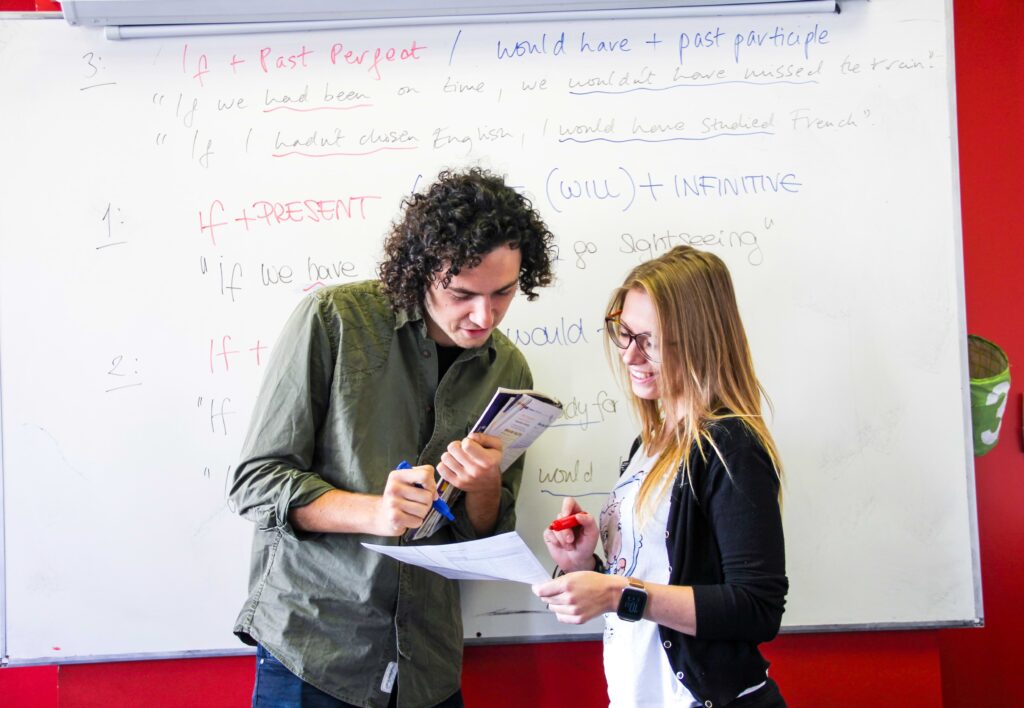
Learning tip: don’t try to memorise giant lists. The British Council recommends meeting phrasal verbs in context and recycling them in real tasks. Keep a small, active set and use it this week.
1. How particles shape meaning
Seeing patterns helps memory. A few common tendencies:
- up – completion or improvement: finish up, tidy up, cheer up.
- out – removal, discovery, or distribution: cross out, find out, hand out.
- off – separation or stopping: cut off, turn off, take off (remove).
- on – continuation or attachment: carry on, put on (clothes), try on.
Teacher resources and grammar guides explain that particles often add this “extra meaning” to the base verb, which is why phrasal verbs are so productive in everyday English.
2. Mini-drills that build fluency
- Shadow two lines. Play a short clip and speak along a fraction behind it. Focus on stress on the particle: turn off, pick up.
- Swap the object. Practise split forms where possible: pick it up, turn it down.
- Personalise fast. Write three true sentences using today’s verbs. Then say them out loud.
Macmillan’s pronunciation notes emphasise stress on the particle in typical sentences, which is exactly what these drills train.
3. Quick checks: separable or not?
Some verbs split with a short object (pick it up), some do not (look after it → no split), and some allow both (work out the answer / work the answer out). Good learner dictionaries mark this clearly and give natural examples. Keep one open while practising.
4. 60-second review
Say these aloud with your own details.
- I picked up ___ from that video and I’ll try it today.
- We need to sort out ___ before Friday.
- I’ve taken up ___ and I’m trying to carry on every evening.
- Let’s catch up on ___ after class.
- I finally worked out ___, so I won’t put it off again.
Consistency beats intensity. Ten focused minutes a day with real sentences will change how you sound and how easily people understand you. Practising alone works, but getting feedback really ramps up the pace.
Speak Up London’s General English course offers structured speaking drills, real-world listening, and weekly goals to help phrasal verbs transition from your notebook to fluent conversation. If you’re learning English, watching movies and shows can actually help you pick up new words and phrases in a fun way, making your vocabulary grow naturally and systematically.
